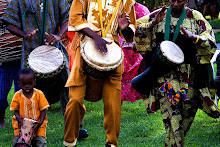
"All strong peoples emphasize their history all the time; weak peoples do not." - Runoko Rashidi
Watch, listen, & learn. Click the links below for the daily lesson:
Lesson 01 - The Pre-test
Lesson 02 - The history of Black History
Lesson 03 - The Global African Presence
Lesson 04 - Ancient African Migrations
Lesson 05 - African Slavery and Islam
Lesson 06 - The world has African ancestors
Lesson 07 - Biblical Black History # 1 - Return to Glory
Lesson 08 - Blacks in America before the Pilgrims
Lesson 09 - The American Slave Trade (Ma'afa)
Lesson 10 - Black Cowboys
Lesson 11 - Queen Mother Moore
Lesson 12 - America's first Black Millionaire
Lesson 13 - Black History and The Moors # 1
Lesson 14 - Biblical Black History # 2 - Black to the Bible
Lesson 15 - Black History in the Holy Koran
Lesson 16 - The Afro-Latinos
Lesson 17 - The Afro-Latinos #2: Puerto Rico
Lesson 18 - The Afro-Latinos #3: Mexico
Lesson 19 - Black Indians (American Indians)
Lesson 20 - The Black Jews
Lesson 21 - Biblical Black History # 3 - African influences
Lesson 22 - American Songs of Freedom
Lesson 23 - Black American Inventions
Lesson 24 - Salsa Music's Black History
Lesson 25 - African Martial Arts
Lesson 26 - Black History and the Blues
Lesson 27 - The Post Test
Created by Seko VArner and Larry Brayboy of The Imani Foundation for The Imani Foundation
To learn more about Runoko Rashidi click here !
Showing posts with label Black History. Show all posts
Showing posts with label Black History. Show all posts
Friday, November 14, 2008


Lesson 01 of 26 History of Black History

The American Negro must remake his past in order to make his future . . . History must restore what slavery took away. - Arthur Schomburg
Black History, as we  currently know it, has it's main roots in four figures. Three men, one woman. Three were African-Americans (by today's standards), one was a Puerto Rican. Many others influenced these figures, yet we focus on these four. The Great Grandfather of Black History is W.E.B Dubois. The Grandfather of Black History is Arturo Schomberg. The Mother of Black History is Drusilla Houston, and the Father of Black History is Carter G. Woodson.
 currently know it, has it's main roots in four figures. Three men, one woman. Three were African-Americans (by today's standards), one was a Puerto Rican. Many others influenced these figures, yet we focus on these four. The Great Grandfather of Black History is W.E.B Dubois. The Grandfather of Black History is Arturo Schomberg. The Mother of Black History is Drusilla Houston, and the Father of Black History is Carter G. Woodson.
(Photo: W.E.B. Dubois)
Simply put in 1903 W.E.B. DuBois published a book named "The Souls of Black Folk." Dubois' book taught and inspired both the Puerto-Rican Arturo Schomberg, and the Woman-Journalist Drusilla Houston. The writing of Dubois, and the research of Schomberg taught and inspired Woodson, who created Negro History week with some assistance from members of Woodson's fraternity Omega Psi Phi and others who supported Woodson's activities. As a Pan-Hellenic side note, W.E.B. Dubois is a member of Alpha Phi Alpha, Arturo Schomberg is a member of Kappa Alpha Psi. 

(Photo Arturo Alfonso Schomburg)
Woodson's later activities, most notably the initiation of Negro History Week, have inspired people of African descent worldwide to improve self-racial pride and laid the foundation for the United States of America to recognize February as Black History month. Houston's works have inspired many scholars, particularly scholars who have studied African and African-diaspora history, to further the scholarly work associated with Black History. Put very simply, Woodson's activities reached the common person and general cultural aptitude, while Houston's work reached the scholars.
It's interesting to note that the Mother and Father of Black History had some difficulties. Woodson dismissed Houston as a “historian without portfolio” and didn't consider her to be a serious historian. As Woodson introduced Negro History week in 1926, Houston published her groundbreaking burst on the historical literary scene with Volume I of her magnum opus "Wonderful Ethiopians of the Ancient Cushite Empire Book 1: Nations of the Cushite Empire, Marvelous Facts from Authentic Records". Daddy started Black History week, Mama provided the ancient information that supported Black History week. Thanks Mom & Dad !
 (Photo: Drusilla Huston)
Drusilla Dunjee (later Houston) was born on January 20, 1876 in Harper's Ferry, West Virginia. Her parents were Rev. John William Dunjee and Lydia Taylor Dunjee. Houston was always fearful that her works would be lost and forgotten and that they would never reach the audience she desired, namely the children. To some extent she was correct. On February 11, 1941, Houston died in Arizona after years of illness from Tuberculosis. True to faith, her grave reads: “To Die is to Gain.”
Visit http://www.abwh.org/ddhouston.htm for more information on The Mother of Black History.
William Edward Burghardt Du Bois was born on February 23, 1868, in Great Barrington, at the southwestern edge of Massachusetts, to Alfred Du Bois and Mary Silvina Burghardt Du Bois. Du Bois was born and grew up in the overwhelmingly white town of Barrington, Massachusetts. Mary Silvina Burghardt's family was part of the very small, free black population of Great Barrington and had long owned land in the state. They descended from Dutch and African ancestors, including Tom, a West African-born man who served as a private for Captain John Spoor's company in 1780, a service which likely won him his freedom. According to Du Bois, several of his maternal ancestors were notably involved in regional history.
Alfred Du Bois, from Haiti, was of French Huguenot and African descent.
Alfred Du Bois, from Haiti, was of French Huguenot and African descent.
Schomburg was born in the (previously predominately "Black") town of Santurce, Puerto Rico (now part of San Juan) to María Josefa, a freeborn Black midwife from St. Croix, and Carlos Féderico Schomburg, a bi-racial merchant of German heritage. Schomburg was educated at San Juan's Instituto Popular, where he learned commercial printing, and at St. Thomas College in the Danish-ruled Virgin Islands, where he studied Negro Literature. During grade school one of his teachers claimed that blacks had no history, heroes or accomplishments; this patently false claim inspired Schomburg's life-long quest to find the truth and to document the accomplishments of African-Latinos, such as Jose Campeche and later of Afro-Americans.

Lesson 01 - The Black History Pre-test

This is an online Black History class. The term "Black" will refer to people of African ancestry throughout this class. This designation of Black does not remove or ignore any other ancestral influences that are a part of a persons, peoples, or a cultures make-up. Black History, in this context, is not limited to 'Black Americans', rather it deals with historical information that has any connection to African or Negroid influences. On with the course...
Lesson 1: Learn what you don't know about Black History:
Ask yourself the following questions (Pre-test). Click through the links and watch/read/listen to online lessons. After completing all of the lessons, take the Post test and see what you have learned.
01. Who is the mother of Black History? What did the father of Black History say about her ?
02. What ancient African presence can be found in India ?
03. What are the main three migrations have created the African Diaspora (Spreading out) ?
04. What part did Arabs play in the African enslavement process ?
05. Chiek Anta Diop taught that all people came from Africa, what did IBM discover ?
06. What do some Christian historians mean by an African "Return to Glory ?"
07. Who did the early explorers discover along with the Indians of North & South America ?
08. What is the term Ma'Afa refer to ?
09. What are some of the reasons that ex-enslaved Africans became Cowboys ?
10. How did Queen Mother Moore receive her position of Queen ?
11. Who was Sarah Bledloe and how did she become so rich ?
12. Who were the Moors ?
13. Who were the Blacks noted in the Holy Bible ?
14. Who were the Blacks noted in the Holy Koran ?
15. What created the African influence in Latino / Hispanic culture ?
16. Name three African influences upon Puerto-Rican culture.
17. Name an area of Mexico where Mexico's African heritage is still apparent.
18. How did some American-Indians avoid being walking the Trail of Tears ?
19. Name three groups that are both Black and Jewish.
20. What are some Biblical references to the African influence upon the Hebrews ?
21. What does the Pentatonic scale have to do with Negro Spirituals ?
22. Name three American (U.S.A.) inventions that were created by Blacks in America.
23. What does Salsa Music have to do with Black people ?
24. Name three African Martial Arts.
25. What American (U.S.A.) area produced the first Blues-Music songs ?
26. How can the information in this class improve your life ?
Lesson 03 of 26 - The Global African Presence
The Global African Presence is a Runoko Rashidi slide-presentation lecture focusing on the African presence around the world, ancient and modern, but with an emphasis on antiquity. It examines the African origins and evolution of humanity, the African origins of and presence in classical civilizations, and the present locations and conditions of African people. The Global African Presence referrs to all of the Black populations that have peopled the planet within both the prehistoric and historic periods. The words African and Black are used interchangeably, as synonyms. This includes Africans as the first modern humans, the subsequent migrations and movements of African people, and the later involuntary arrival of African people around the world as the result of enslavement.
The Video: 2/6/2000 Runoko Rashidi provides his slide lecture entitled "Unexpected faces in unexpected places. The Global African Presence." This presentation occured at Old Dominion University in Norfolk Virginia. His presentation was sponsored by the Tau Lambda chapter of Omega Psi Phi, The Imani Foundation, and Positive Vibes Entertainment. The presentation shows people of African descent throughout the world.
The Video: 2/6/2000 Runoko Rashidi provides his slide lecture entitled "Unexpected faces in unexpected places. The Global African Presence." This presentation occured at Old Dominion University in Norfolk Virginia. His presentation was sponsored by the Tau Lambda chapter of Omega Psi Phi, The Imani Foundation, and Positive Vibes Entertainment. The presentation shows people of African descent throughout the world.
Lesson 04 of 26 Ancient Black Migrations and Dr Yosef Ben Jochannan
The migrations of African people !
Christian Warning ! This video contains some information that may challenge commonly held beliefs of Christians. You're relationship with God is the most important relationship. If information that challenges your beliefs are disturbing, please skip this section and proceed with another lesson.
Christian Warning ! This video contains some information that may challenge commonly held beliefs of Christians. You're relationship with God is the most important relationship. If information that challenges your beliefs are disturbing, please skip this section and proceed with another lesson.
Lesson 05 of 26 African Slaves and Islam
This is a work by John Alembillah Azumah detailing the effect Arab-Islam has had on Africa. The book is called "Legacy of Arab-Islam in Africa: A Quest for Inter-Religious Dialogue." John Alembillah Azumah is in Hyderabad, India. He is an expert on Islam in Africa, and has published widely on this subject. Certain words in the Arabic language demonstrate just how their supremacy is ingrained in Arabic (and all Semitic) culture. For instance, the word for "slave" is abd, Abdullah means the "slave of Allah," where all Blacks/Africans are called Abeed (plural for slaves). You find similarly in Hebrew, Obed means "servant".
While slavery only lasted 3 centuries in the west, it has lasted 14 centuries in the Middle East and exists today in many Muslim countries. Another interesting fact was that the Arabic-Islamic slave trade in the trans-Saharan and East African slave markets had mortality rates as high as 80-90%, where the trans-Atlantic slave trade with Europeans is estimated at 10%. Also, in the trans-Atlantic, there were 2 men for every woman that went to the Americas. However, it was reversed with the Arabic-Islamic slave trade in that it took 2 women for every man (where all men were castrated). We can easily imagine the reason the Arabs demanded these gender ratios. With the men already being castrated, the children born to the women were regularly killed at birth, which explains why there is not African/Black population in West Asia, like that in Brazil and the United States. The death toll of Africans from the trans-Saharan and East African Islamic slave trade may be upwards of 140 million souls. -------
History of slavery and slaves in saudi arabia, chad, sudan and nigeria. dhimmitude is the status that Islamic law, the sharia, mandates for non-muslims. they are dhimmis (dhimmi). jihad with islamist. islamism and islamists have shariah.
While slavery only lasted 3 centuries in the west, it has lasted 14 centuries in the Middle East and exists today in many Muslim countries. Another interesting fact was that the Arabic-Islamic slave trade in the trans-Saharan and East African slave markets had mortality rates as high as 80-90%, where the trans-Atlantic slave trade with Europeans is estimated at 10%. Also, in the trans-Atlantic, there were 2 men for every woman that went to the Americas. However, it was reversed with the Arabic-Islamic slave trade in that it took 2 women for every man (where all men were castrated). We can easily imagine the reason the Arabs demanded these gender ratios. With the men already being castrated, the children born to the women were regularly killed at birth, which explains why there is not African/Black population in West Asia, like that in Brazil and the United States. The death toll of Africans from the trans-Saharan and East African Islamic slave trade may be upwards of 140 million souls. -------
History of slavery and slaves in saudi arabia, chad, sudan and nigeria. dhimmitude is the status that Islamic law, the sharia, mandates for non-muslims. they are dhimmis (dhimmi). jihad with islamist. islamism and islamists have shariah.
Lesson 06 of 27 (February 7th) We are all Africans
"Where do you really come from? And how did you get to where you live today? DNA studies suggest that all humans today descend from a group of African ancestors who—about 60,000 years ago—began a remarkable journey." -
The Genographic Project
The Genographic Project
Lesson 07 of 26 Biblical Black History # 1
A Christian approach to ancient African history. Learn about Biblical Black History. Visit http://www.returntoglory.org/ for additional details about this Black-History Christian ministry.
Video: Speaker is Dr. John Berkeley. This post has nothing to do with the fact that there is no color in Christ...this is simply historical facts...which is not about faith or salvation. Historical facts that have been hidden for ages. There's no need to get spiritual on here....if you do then you missed the point all together. Humble yourself and learn your history.
Video: Speaker is Dr. John Berkeley. This post has nothing to do with the fact that there is no color in Christ...this is simply historical facts...which is not about faith or salvation. Historical facts that have been hidden for ages. There's no need to get spiritual on here....if you do then you missed the point all together. Humble yourself and learn your history.
Lesson 08 of 27 Blacks before the Pilgrims
Lecture given by Dr Ivan Van Sertima discussing African history in the Americas prior to Chistopher Columbus. Recorded in 1986 at Camden Town Hall, London. Caribbean Cultural International & Karnak House.
Lesson 09 of 26 The Maafa (In the Americas)
The Ma'afa means 'catastrophe' in Swahili. The Ma'afa is most commonly used when describing or referring to the process of enslaving Africans in the Americas.
Slavery in the United States began soon after English colonists first settled Virginia in 1607 and lasted as a legal institution until the passage of the Thirteenth Amendment to the United States Constitution in 1865. It continues illegally to this day. Before the widespread establishment of chattel slavery, much labor was organized under a system of bonded labor known as indentured servitude. This typically lasted for several years for white and black alike, and it was a means of using labor to pay the costs of transporting people to the colonies. By the 18th century, court rulings established the racial basis of the American incarnation of slavery to apply chiefly to Black Africans and people of African descent, and occasionally to Native Americans.
A 1705 Virginia law stated slavery would apply to those peoples from nations that were not Christian. In part because of the success of tobacco as a cash crop in the Southern colonies, its labor-intensive character caused planters to import more slaves for labor by the end of the 17th century than did the northern colonies. The South had a significantly higher number and proportion of slaves in the population. Religious differences contributed to this geographic disparity as well. From 1654 until 1865, slavery for life was legal within the boundaries of much of the present United States. Most slaves were black and were held by whites, although some Native Americans and free blacks also held slaves; there were a small number of white slaves as well. The majority of slave holding was in the southern United States where most slaves were engaged in an efficient machine-like gang system of agriculture. According to the 1860 U.S. census, nearly four million slaves were held in a total population of just over 12 million in the 15 states in which slavery was legal. Of all 8,289,782 free persons in the 15 slave states, 393,967 people (4.8%) held slaves, with the average number of slaves held by any single owner being 10.
The majority of slaves were held by planters, defined by historians as those who held 20 or more slaves.Ninety-five percent of black people lived in the South, comprising one-third of the population there, as opposed to 2% of the population of the North. The wealth of the United States in the first half of the 19th century was greatly enhanced by the labor of African Americans. But with the Union victory in the American Civil War, the slave-labor system was abolished in the South. This contributed to the decline of the post-bellum Southern economy, but it was most affected by the continuing decline in the price of cotton through the end of the century. That made it difficult for the region to recover from the war, as did its comparative lack of infrastructure, which kept products from markets. The South faced significant new competition from foreign cotton producers such as India and Egypt. Northern industry, which had expanded rapidly before and during the war, surged even further ahead of the South's agricultural economy. Industrialists from northeastern states came to dominate many aspects of the nation's life, including social and some aspects of political affairs. The planter class of the South lost power temporarily. The rapid economic development following the Civil War accelerated the development of the modern U.S. industrial economy.
Twelve million Africans were shipped to the Americas from the 16th to the 19th centuries Of these, an estimated 645,000 were brought to what is now the United States. The largest number were shipped to Brazil. The slave population in the United States had grown to four million by the 1860 Census.
Slavery in the United States began soon after English colonists first settled Virginia in 1607 and lasted as a legal institution until the passage of the Thirteenth Amendment to the United States Constitution in 1865. It continues illegally to this day. Before the widespread establishment of chattel slavery, much labor was organized under a system of bonded labor known as indentured servitude. This typically lasted for several years for white and black alike, and it was a means of using labor to pay the costs of transporting people to the colonies. By the 18th century, court rulings established the racial basis of the American incarnation of slavery to apply chiefly to Black Africans and people of African descent, and occasionally to Native Americans.
A 1705 Virginia law stated slavery would apply to those peoples from nations that were not Christian. In part because of the success of tobacco as a cash crop in the Southern colonies, its labor-intensive character caused planters to import more slaves for labor by the end of the 17th century than did the northern colonies. The South had a significantly higher number and proportion of slaves in the population. Religious differences contributed to this geographic disparity as well. From 1654 until 1865, slavery for life was legal within the boundaries of much of the present United States. Most slaves were black and were held by whites, although some Native Americans and free blacks also held slaves; there were a small number of white slaves as well. The majority of slave holding was in the southern United States where most slaves were engaged in an efficient machine-like gang system of agriculture. According to the 1860 U.S. census, nearly four million slaves were held in a total population of just over 12 million in the 15 states in which slavery was legal. Of all 8,289,782 free persons in the 15 slave states, 393,967 people (4.8%) held slaves, with the average number of slaves held by any single owner being 10.
The majority of slaves were held by planters, defined by historians as those who held 20 or more slaves.Ninety-five percent of black people lived in the South, comprising one-third of the population there, as opposed to 2% of the population of the North. The wealth of the United States in the first half of the 19th century was greatly enhanced by the labor of African Americans. But with the Union victory in the American Civil War, the slave-labor system was abolished in the South. This contributed to the decline of the post-bellum Southern economy, but it was most affected by the continuing decline in the price of cotton through the end of the century. That made it difficult for the region to recover from the war, as did its comparative lack of infrastructure, which kept products from markets. The South faced significant new competition from foreign cotton producers such as India and Egypt. Northern industry, which had expanded rapidly before and during the war, surged even further ahead of the South's agricultural economy. Industrialists from northeastern states came to dominate many aspects of the nation's life, including social and some aspects of political affairs. The planter class of the South lost power temporarily. The rapid economic development following the Civil War accelerated the development of the modern U.S. industrial economy.
Twelve million Africans were shipped to the Americas from the 16th to the 19th centuries Of these, an estimated 645,000 were brought to what is now the United States. The largest number were shipped to Brazil. The slave population in the United States had grown to four million by the 1860 Census.
Lesson 10 of 26 Black Cowboys
This documentary fills in some of the gap about the stories told and not told about the Black cowboys.
This is a short documentary about African-American rodeo cowboys in the 50s, 60s, and 70s.
This is a short documentary about African-American rodeo cowboys in the 50s, 60s, and 70s.
Lesson 11 of 26 Queen Mother Moore
Audley Moore became an ancestor on May 2 at the age of 98 in 1997. She was given the honorary title of `Queen Mother' by an Ashanti tribe in Ghana.
Mother Moore lived a long and active life, dedicated to public service and improvement of the lives of African-Americans. Born on July 28, 1898 in New Iberia, LA, to second generation freed blacks, she became a revered public figure in Harlem, best known as an advocate for Africa and African-Americans. Moore's ideas and teachings of Pan-African Nationalism was influenced by great political personalities such as W.E.B. DuBois and Marcus Garvey. As a civil rights activist, Mother Moore worked on the defense of the Scottsboro boys. Internationally, she spoke on her disapproval of the Italo-Ethiopian war.
"I am not a part-time struggler,' she once said. `I'm in the movement for the liberation of African people full-time, 7 days a week, 24 hours per day, for life."
Her career was influenced by the violence and hatred she endured as a young child and young woman. While in the fourth grade, Moore's parents died and thus ended her formal education. During World War I while in Alabama, Moore was a volunteer nurse who involved herself in the first of her movements for the equality of blacks by organizing support services for black soldiers that were denied by the Red Cross.
Mother Moore was drawn to the idea of black nationalism and economic independence by the oratory of Marcus Garvey, founder of the Harlem-based Universal Negro Improvement Association. She became an active member of the organization, and founded the Harriet Tubman Association to better the conditions of black women. Through this organization, Moore advocated issues such as higher wages, better education, and the lowering of food prices to help improve the conditions of the poor. Following her brief membership in the Communist party--at the time, the only organization that accepted her radical ideas--she focused her attention on seeking economic reparations for descendants of the victims of slavery, cultural identity, and education. She launched a national campaign in support of economic reparations. Moore believed that economic reparations were the first constructive step in black nationalists ideology.
As an orator, her rhetoric on this issue was powerful:
"Ever since 1950, I've been on the trail fighting for reparations. They owe us more than they could ever pay. They stole our language; they stole us from our mothers and fathers and took our names from us. They worked us free of charge 18 hours a day, 7 days a week, under the lash for centuries. We lost over 100 million lives in the traffic of slavery."
In 1962, Mother Moore met with President John F. Kennedy, the United Nations, and the Congressional Black Caucus about the issue of economic reparations. She later organized and directed the Reparations Committee of Descendants of United States Slaves.
One of her last public appearances was at the Million Man March in Washington, DC. Although weak, her poignant speech was delivered by an associate.
http://www.queenmothermoore.org/mission.htm
Lesson 12 of 26 - USA's 1st Fe-millionaire
Born Sarah Bledloe, Madam C.J. Walker (December 23, 1867 May 25, 1919) was an American businesswoman, hair care entrepreneur, tycoon and philanthropist. Her fortune was made by developing and marketing a hugely successful line of beauty and hair products for black women. The Guinness Book of Records cites Walker as the first female, black or white, who became a millionaire by her own achievements.
Lesson 13 of 26 Blacks and Moors # 1
This is a clip from the documentary called Prince Among Slaves. Its about Abdul Rahman Ibrahim Ibn Sori, who was a prince from Timbo, West Africa, in what is present day Guinea, Fouta Djallon. In 1788 he was kidnapped from Africa after being DEFEATED in battle and taken to Natchez, Mississippi. After 40 years of slavery he was released. Part of that released involved him, being mistaken for a Moor from the Americas. Why so, for one the sultan they are talking about is not the sultan from Africa the continent but the one in the Americas.
The Kingdom of Morocco of the east, on the continent of Africa did not get their independence and sovereignty until 1956. Also we are talking about Ancient Morocco that the modern day Kingdom of Morocco is named after, who shares a name and flag with the ancient Moorish Empire or Moorish Amexem Empire. The Ancient Morocco which was North, Central, South America and the Caribbean, has a flag that goes back about 10,000 to 50,000 years old. Also they ASSUMED he was a Moor. How do they know what a Moor look like? What a Moor wears? They also gave him a fez to put on his head. For more information about Abdul Rahman Ibrahim Ibn Sori you can watch the full documentary, for quick information and reference go to the following link: - http://en.wikipedia.org/wiki/Prince_Among_Slaves - The ancient Moors or Moorish inhabitants of the Americas was labeled through written history and after being defeated in war as Negro, Black, Colored, Afro and African American, West Indian, Indian, Black Indians and other misnomers. In history they were also known as free blacks, free negros, free colored people, or as stated in the Dred Scott vs Sanford case as free native-born inhabitants.
The Kingdom of Morocco of the east, on the continent of Africa did not get their independence and sovereignty until 1956. Also we are talking about Ancient Morocco that the modern day Kingdom of Morocco is named after, who shares a name and flag with the ancient Moorish Empire or Moorish Amexem Empire. The Ancient Morocco which was North, Central, South America and the Caribbean, has a flag that goes back about 10,000 to 50,000 years old. Also they ASSUMED he was a Moor. How do they know what a Moor look like? What a Moor wears? They also gave him a fez to put on his head. For more information about Abdul Rahman Ibrahim Ibn Sori you can watch the full documentary, for quick information and reference go to the following link: - http://en.wikipedia.org/wiki/Prince_Among_Slaves - The ancient Moors or Moorish inhabitants of the Americas was labeled through written history and after being defeated in war as Negro, Black, Colored, Afro and African American, West Indian, Indian, Black Indians and other misnomers. In history they were also known as free blacks, free negros, free colored people, or as stated in the Dred Scott vs Sanford case as free native-born inhabitants.
Lesson 14 of 26 Biblical Black History # 2
Rev. Jeffrey A. Johnson Jr. preaches/teaches his Black to the Bible Vol. 1 - "The Biblical Black Presence." The lecture/sermon contains historical information and Biblical doctrine supporting the presence of African people and people of African descent in the standard canonized Bible. This file is the first sermon/lecture in an educational four part series.
Contact Eastern Star to present your thoughts for improvements or corrections:
http://www.easternstarchurch.org/contact_us . Rev. Jeffrey A. Johnson Jr. preaches/teaches his Black to the Bible Vol. 1 - "The Biblical Black Presence." The lecture/sermon contains historical information and Biblical doctrine supporting the presence of African people and people of African descent in the standard canonized Bible.
This is the first and second sermon/lecture in an educational four part series. Hit http://www.easternstarchurch.org for more information about Rev. Jeffrey A. Johnson Jr. or call 317-591-5057 to purchase this lecture legally. This file is for educational use only. All rights to the lecture portion remain with the Eastern Star Church. This file contains music embeded as background. All music rights remain with respective companies.
www.easternstarchurch.org
Contact Eastern Star to present your thoughts for improvements or corrections:
http://www.easternstarchurch.org/contact_us . Rev. Jeffrey A. Johnson Jr. preaches/teaches his Black to the Bible Vol. 1 - "The Biblical Black Presence." The lecture/sermon contains historical information and Biblical doctrine supporting the presence of African people and people of African descent in the standard canonized Bible.
This is the first and second sermon/lecture in an educational four part series. Hit http://www.easternstarchurch.org for more information about Rev. Jeffrey A. Johnson Jr. or call 317-591-5057 to purchase this lecture legally. This file is for educational use only. All rights to the lecture portion remain with the Eastern Star Church. This file contains music embeded as background. All music rights remain with respective companies.
www.easternstarchurch.org
Lesson 15 of 27 Black History in Islam
 THE GLOBAL AFRICAN COMMUNITY HISTORY NOTES:
THE AFRICAN PRESENCE IN EARLY ARABIA -
BY RUNOKO RASHIDI
The Arabian Peninsula was early populated by Black people. Once dominant over the entire peninsula, the African presence in early Arabia is most clearly traceable through the Sabeans. The southwestern corner of the peninsula was their ancient home. This area is today called Yemen. In antiquity this region gave rise to a high degree of civilization because of the growth of frankincense and myrrh. The city of Makkab was considered a holy place and the destination of pilgrims long before the prophet Muhammad. Muhammad himself, who was to unite the whole of Arabia, appears to have had a prominent African lineage. According to al-Jahiz, the guardian of the sacred Kaaba, Abd-al-Muttalib, "fathered ten Lords, Black as the night and magnificent." One of these men was Abdallah, the father of the Prohpet Muhammad.
According to tradition, the first Muslim killed in battle was Mihja--a Black man. Another Black man, Bilal, was such a pivotal figure in the development of Islam that he has been referred to as "a third of the faith."
Many of the earliest Muslim converts were Africans, and a number of the Muslim faithful sought refuge in Ethiopia because of initial Arabian hostility to Muhammad's teachings. It was this relationship which caused Muhammad to declare that, "Who brings an Ethiopian man or an Ethiopian woman into his house, brings the blessings of God there."
[1998] Runoko Rashidi. All Rights Reserved.
Runoko may be researched here: http://www.cwo.com/~lucumi/runoko.html
Lesson 16 of 26 - Afro Latinos


Afro-Latinos :
(Photo - Two Nicaraguan dancers)
Some people of African origin first arrived in the Americas with the Spanish and Portuguese in the 15th and 16th centuries. For example, Pedro Alonso Niño, traditionally considered the first of many New World explorers of African descent [7] was a navigator in the 1492 Columbus expedition. Those who were directly from Africa mostly arrived in Latin America as part of the Atlantic slave trade, as agricultural, domestic, and menial laborers and as mineworkers. They were also employed in mapping and exploration (for example, Estevanico) and were even involved in conquest (for example, Juan Valiente). They were mostly brought from West Africa and Central Africa in what are now the nations of Nigeria, Ghana, Benin, Angola, and Congo, There are three major groups: the Yoruba, Akan, and the Bantu. Most of the enslaved Africans were sent to Brazil, Peru, and the Caribbean, but lesser numbers went to Colombia and Venezuela. Countries with significant black, mulatto, or zambo populations today include Brazil (86 million), Colombia (10 million), Haiti (8.7 million), Dominican Republic (4 million), Cuba (up to 4 million), and Puerto Rico (20%-46%). Recent genetic research in UPR Mayaguez has brought to light that 26.4% of Puerto Ricans have African heritage on the X chromosome and 20% on the Y chromosome, thus between 20%-46% of the Puerto Rican population has African heritage.
 Dominican Republic (4 million), Cuba (up to 4 million), and Puerto Rico (20%-46%). Recent genetic research in UPR Mayaguez has brought to light that 26.4% of Puerto Ricans have African heritage on the X chromosome and 20% on the Y chromosome, thus between 20%-46% of the Puerto Rican population has African heritage.
(Photo - Rastafarian Afro-Cubans)
The mix of these African cultures with the Spanish, Portuguese, French, and indigenous cultures of Latin America has produced many unique forms of language (e.g., Palenquero, Garífuna and Creole), religions (e.g., Candomblé, Abakuá, Santería, Lucumi and Vodou), music (e.g., kompa, salsa, bachata, cumbia, Palo de Mayo, plena), samba, martial arts (capoeira) and dance (rumba, merengue).

The African presence in Nicaragua.
The African presence in the Dominican Republic.
The African presence in Brazil.
The African presence in Cuba.
(Photo - Mardi Gras in the Dominican Republic)

Blackout: How Argentina ‘Eliminated’ Africans From Its History And Conscience
Tens of millions of black Africans were forcibly removed from their homelands from the 16th century to the 19th century to toil on the plantations and farms of the New World. This so-called “Middle Passage” accounted for one of the greatest forced migrations of people in human history, as well as one of the greatest tragedies the world has ever witnessed.
Millions of these helpless Africans washed ashore in Brazil -- indeed, in the present-day, roughly one-half of the Brazilian population trace their lineage directly to Africa. African culture has imbued Brazil permanently and profoundly, in terms of music, dance, food and in many other tangible ways.
But what about Brazil's neighbor, Argentina? Hundreds of thousands of Africans were brought there as well – yet, the black presence in Argentina has virtually vanished from the country’s records and consciousness.
According to historical accounts, Africans first arrived in Argentina in the late 16th century in the region now called the Rio de la Plata, which includes Buenos Aires, primarily to work in agriculture and as domestic servants. By the late 18th century and early 19th century, black Africans were numerous in parts of Argentina, accounting for up to half the population in some provinces, including Santiago del Estero, Catamarca, Salta and Córdoba.
In Buenos Aires, neighborhoods like Monserrat and San Telmo housed many black slaves, some of whom were engaged in craft-making for their masters. Indeed, blacks accounted for an estimated one-third of the city’s population, according to surveys taken in the early 1800s.
Slavery was officially abolished in 1813, but the practice remained in place until about 1853. Ironically, at about this time, the black population of Argentina began to plunge.
Historians generally attribute two major factors to this sudden “mass disappearance” of black Africans from the country – the deadly war against Paraguay from 1865-1870 (in which thousands of blacks fought on the frontlines for the Argentine military) as well as various other wars; and the onset of yellow fever in Buenos Aires in 1871.
The heavy casualties suffered by black Argentines in military combat created a huge gender gap among the African population – a circumstance that appears to have led black women to mate with whites, further diluting the black population. Many other black Argentines fled to neighboring Brazil and Uruguay, which were viewed as somewhat more hospitable to them.
Others claim something more nefarious at work.
It has been alleged that the president of Argentina from 1868 to 1874, Domingo Faustino Sarmiento, sought to wipe out blacks from the country in a policy of covert genocide through extremely repressive policies (including possibly the forced recruitment of Africans into the army and by forcing blacks to remain in neighborhoods where disease would decimate them in the absence of adequate health care).
Tellingly, Sarmiento wrote in his diary in 1848: “In the United States… 4 million are black, and within 20 years will be 8 [million]…. What is [to be] done with such blacks, hated by the white race? Slavery is a parasite that the vegetation of English colonization has left attached to leafy tree of freedom.”
By 1895, there were reportedly so few blacks left in Argentina that the government did not even bother registering African-descended people in the national census.
The CIA World Factbook currently notes that Argentina is 97 percent white (primarily comprising people descended from Spanish and Italian immigrants), thereby making it the “whitest” nation in Latin America.
But blacks did not really vanish from Argentina – despite attempts by the government to eliminate them (partially by encouraging large-scale immigration in the late 19th and 20th century from Europe and the Near East). Rather, they remain a hidden and forgotten part of Argentine society.
Hisham Aidi, a lecturer at Columbia University's School of International and Public Affairs, wrote on Planete Afrique that in the 1950s, when the black American entertainer Josephine Baker arrived in Argentina, she asked the mixed-race minister of public health, Ramon Carilio: “Where are the Negroes?” In response, Carilio joked: “There are only two -- you and I.”
As in virtually all Latin American societies where blacks mixed with whites and with local Indians, the question of race is extremely complex and contentious.
“People of mixed ancestry are often not considered ‘black’ in Argentina, historically, because having black ancestry was not considered proper,” said Alejandro Frigerio, an anthropologist at the Universidad Catolica de Buenos Aires, according to Planete Afrique.
“Today the term ‘negro’ is used loosely on anyone with slightly darker skin, but they can be descendants of indigenous Indians [or] Middle Eastern immigrants.”
AfricaVive, a black empowerment group founded in Buenos Aires in the late 1990s, claimed that there are 1 million Argentines of black African descent in the country (out of a total population of about 41 million). A report in the Washington Post even suggested that 10 percent of Buenos Aires’ population may have African blood (even if they are classified as “whites” by the census).
"People for years have accepted the idea that there are no black people in Argentina," Miriam Gomes, a professor of literature at the University of Buenos Aires, who is part black herself, told the Post.
"Even the schoolbooks here accepted this as a fact. But where did that leave me?"
She also explained that almost no one in Argentina with black blood in their veins will admit to it.
"Without a doubt, racial prejudice is great in this society, and people want to believe that they are white," she said. "Here, if someone has one drop of white blood, they call themselves white."
Gomes also told the San Francisco Chronicle that after many decades of white immigration into Argentina, people with African blood have been able to blend in and conceal their origins.
"Argentina's history books have been partly responsible for misinformation regarding Africans in Argentine society," she said. "Argentines say there are no blacks here. If you're looking for traditional African people with very black skin, you won't find it. African people in Argentina are of mixed heritage."
Ironically, Argentina’s most famous cultural gift to the world – the tango – came from the African influence.
"The first paintings of people dancing the tango are of people of African descent," Gomes added.
On a broader scale, the “elimination” of blacks from the country’s history and consciousness reflected the long-cherished desire of successive Argentine governments to imagine the country as an “all-white” extension of Western Europe in Latin America.
“There is a silence about the participation of Afro-Argentines in the history and building of Argentina, a silence about the enslavement and poverty,” said Paula Brufman, an Argentine law student and researcher, according to Planete Afrique.
“The denial and disdain for the Afro community shows the racism of an elite that sees Africans as undeveloped and uncivilized.”
Lesson 17 of 26 The Afro-Latinos #2: Puerto Rico
A little history about Puerto Rican's Afro-Borinquen heritage. Note that the Grandfather of Black History, Arturo Schomberg, was Puerto Rican who started the trend to use the term "Afro" when describing people of African descent. Arturo Schomberg called himself an "Afroborinqueño" which means "Afro-Puerto Rican" in the 1890's. Malcolm X, who studied Schomberg's information, is attributed to first use the term Afro-American in the 1960's which later became "African-American" when popularized by Rev. Jesse Jackson Sr. as he began saying the term in the 1980s.
Video # 1
Video # 2
Video # 1
Video # 2
Lesson 18 of 26 The Black Mexicans

Along the highlands and coastal shores of the Atlantic and Pacific ocean, reside a nation of people unknown or forgotten. Many are the descendants of the enslaved Africans transported to this rich tropical land more than 500 hundred years ago. Today they are identified as Afro-Mexican and Afro-Mestizo. Within their communities they are simply Mexicans. The first African slave brought to Mexico is said to be one Juan Cortés, a slave who accompanied the conquistador Hernán Cortés in 1519. The Indians, spellbound by his dark skin, for they had never seen an African before, took him for a god!
Lesson 19 of 26 The Black Indians
"Black Indians: An American Story" is a distinguished documentary which presents the rarely-told story of the racial fusion of Native and African-Americans. It is a story which literally begins with the birth of America, in the presence of the mixed-race Boston Massacre martyr Crispus Attucks, and which follows the deadlier aspects of the 19th century through the Seminole War (where runaway slaves joined Seminole warriors in Florida in armed conflict against the invading U.S. Army) and the expulsion of the Cherokee nation on the infamous Trail of Tears (where black Indians within the Cherokee orbit faced the no-win choice of either leaving with their brethren into forced exile or staying behind to live in slavery).
While Native Americans did not carry the racial hang-ups of white society and did not see mixed-raced Indians as being second-class, white society and 19th century government bureaucrats had no concept of multiculturalism and demanded that everyone be pigeonholed into one racial group, with any questions of identity decided by appearance. Thus, it was not uncommon for black Indian families to find themselves separated by government classifications into completely different racial groups based solely on their color and appearance. This practice was also helpful in erasing official traces of native nations in the late 19th century--mixed race Indians were not considered pure blooded by the Bureau of Indian Affairs and several tribes were declared extinct even though they still lived in the persons of black Indians whose native heritage was not recognized by the government. By the time that civil rights and Native rights movements in the 1960s roared into the national forefront, the story of the black Indians was virtually forgotten except as family histories by those who shared the blended racial heritages. Even today, black Indians meet incredulous skeptics who refuse to acknowledge their ancestral worth.
While Native Americans did not carry the racial hang-ups of white society and did not see mixed-raced Indians as being second-class, white society and 19th century government bureaucrats had no concept of multiculturalism and demanded that everyone be pigeonholed into one racial group, with any questions of identity decided by appearance. Thus, it was not uncommon for black Indian families to find themselves separated by government classifications into completely different racial groups based solely on their color and appearance. This practice was also helpful in erasing official traces of native nations in the late 19th century--mixed race Indians were not considered pure blooded by the Bureau of Indian Affairs and several tribes were declared extinct even though they still lived in the persons of black Indians whose native heritage was not recognized by the government. By the time that civil rights and Native rights movements in the 1960s roared into the national forefront, the story of the black Indians was virtually forgotten except as family histories by those who shared the blended racial heritages. Even today, black Indians meet incredulous skeptics who refuse to acknowledge their ancestral worth.
Subscribe to:
Posts (Atom)